Discovering an active stinging insect colony beneath an architectural eave or behind a siding board introduces immediate domestic disruption and genuine safety concerns. Sacramento properties regularly host colonies of…
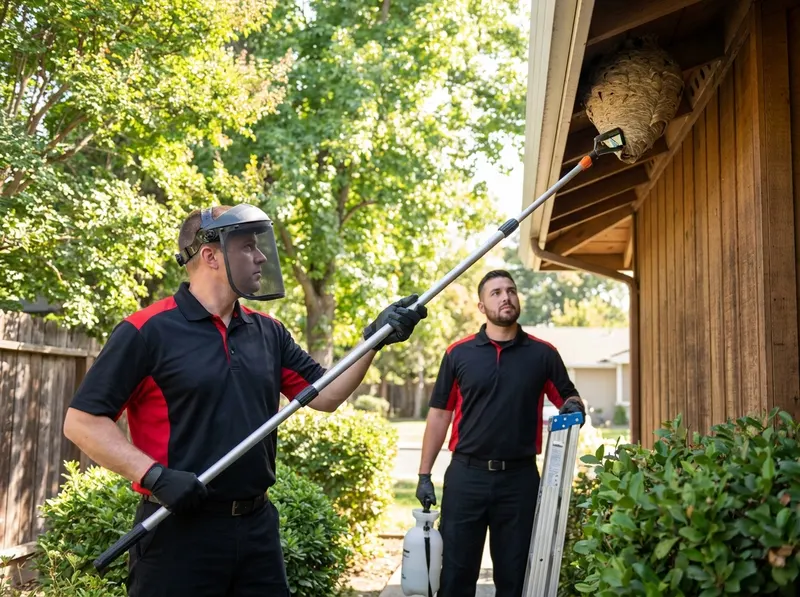
Discovering an active stinging insect colony beneath an architectural eave or behind a siding board introduces immediate domestic disruption and genuine safety concerns. Sacramento properties regularly host colonies of native paper wasps (Polistes species), western yellowjackets (Vespula pensylvanica), and aerial hornets that establish nests in early spring and peak in population during the hot, dry Central Valley late summer. Homes featuring historic deep roof overhangs in East Sacramento and Boulevard Park, dense fruit canopies in Land Park and Curtis Park, or open crawlspace vents in Midtown present sheltered voids where queens initiate construction. Rather than drenching outdoor patios in broad-spectrum broadcast sprays, ProActive Pest Relief deploys focused physical removals guided by the structural principles outlined by the University of California Statewide Integrated Pest Management Program. This method targets the central brood chamber directly, safeguarding household pets, beneficial garden pollinators, and children from unguided pesticide drift.
Ground-nesting yellowjackets frequently occupy abandoned rodent burrows throughout turf perimeters in Pocket-Greenhaven and Natomas, while aerial paper wasps favor second-story rafter tails, window trim, and perimeter shade structures. Standard retail chemical sprays rarely penetrate complex wall voids and often agitate thousands of mature worker insects, forcing them into indoor living spaces through attic penetrations or recessed lighting fixtures. Effective removal requires professional containment gear adhering to NIOSH safety protocols, paired with localized micro-injectors that introduce targeted botanical or mineral dusts directly into entrance voids. Technicians carefully adhere to the pesticide exposure thresholds established by the California Department of Pesticide Regulation, neutralizing the colony at the source before mechanically dislodging the cellulose nest to eliminate brood pheromones that attract secondary scavengers.
The logistical trade-off in stinging insect intervention centers on physical location and accessibility. When a paper wasp nest measures under 4 inches across an accessible first-story eave, treatment and physical scraping take roughly 45 minutes; however, an enclosed yellowjacket colony hidden inside an insulated exterior wall cavity requires acoustic detection, precision entry, and comprehensive structural exclusion to seal the migration route permanently. ProActive Pest Relief coordinates with localized municipal safety frameworks, maintaining awareness of vector management guidelines supported by the Sacramento-Yolo Mosquito and Vector Control District and environmental safeguards established by the U.S. Environmental Protection Agency. For complex structural extractions involving Honey Bee (Apis mellifera) swarms, work aligns with local agricultural preservation guidance from the Sacramento County Department of Agriculture to facilitate humane relocation with local apiarists whenever feasible. Homeowners avoid rigid quarterly subscription traps, securing calm, one-time remedial relief backed by physical caulking of gaps along fascia lines, exterior vents, and soffits.
Every job gets a firm, written price after a free on-site visit.
For standards, safe disposal, and service guidance on PEST CONTROL SEVICE in Sacramento, CA, useful references include U.S. EPA, ENERGY STAR, U.S. Dept. of Energy, Consumer.gov, U.S. Census Bureau, and Google Maps. General consumer and small-business resources are available from USA.gov, Better Business Bureau, FTC Consumer Advice, U.S. Small Business Administration, and Ready.gov.
Tell us about your stinging insect nest removal job in Sacramento and we'll send a clear, written quote, usually the same day.
 ProActive Pest Relief